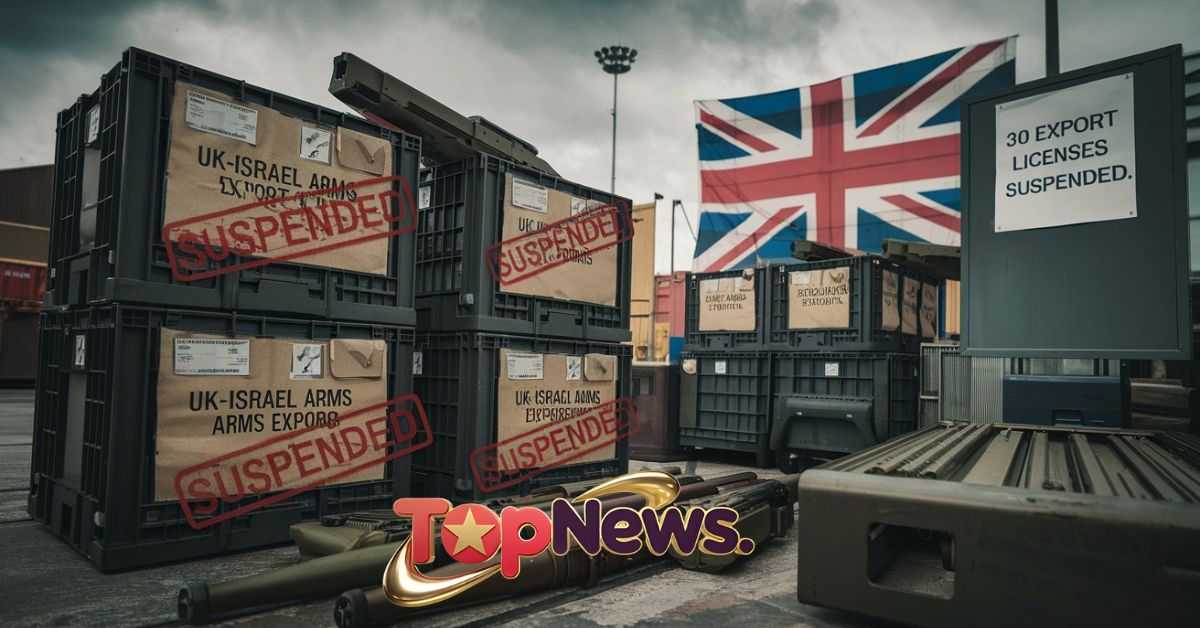
The new Labour government in the UK has swiftly suspended 30 arms export licenses to Israel after a recent review revealed a “clear risk” that UK-supplied arms could be used in serious violations of humanitarian law, particularly concerning the treatment of Palestinian detainees and the provision of aid to Gaza.
The suspension affects components for military aircraft, including fighter jets, helicopters, and drones.
The Foreign Office, following a two-month review, expressed concerns about Israel’s conduct in the Gaza conflict. While no definitive conclusion has been reached regarding the role of UK arms in the destruction in Gaza, the extensive damage and high civilian death toll have raised significant alarm.
These suspended licenses represent about one-tenth of the 350 active licenses and do not include parts for the F-35 Joint Strike Fighter program, except when the UK-supplied component is specific to jets used exclusively by Israel.
This decision, coordinated between the Foreign Office, the business department, and the attorney general, is expected to help Foreign Secretary David Lammy navigate a potentially contentious Labour Party annual conference.
However, it may strain relations with the Biden administration in the US, which has consistently argued that there is no basis in international humanitarian law to halt arms exports.
The UK government is currently facing a growing number of domestic court challenges, with new proceedings set to begin on Tuesday.
Officials were hesitant to directly link the suspension of the 30 arms export licenses to specific violations of international humanitarian law. However, they noted that the government has been unsuccessfully negotiating with Israel to secure access to Palestinian detainees, either through British judicial representatives or the International Committee of the Red Cross.
Ministers were keen to clarify that the suspension does not signal a shift away from the UK’s commitment to Israel’s security, emphasizing that similar suspensions have occurred during previous conflicts involving Israel.
Such decisions have historical precedent, having been endorsed by Margaret Thatcher in 1982, Gordon Brown in 2009, and under the coalition government in 2014. Additionally, arms export licenses were suspended for Egypt in 2013 and Russia in 2014.
Officials also mentioned that David Lammy and his team were not given access to the decision-making process on arms sales made by the previous Conservative government. However, Labour ministers likely reached a different conclusion based on similar evidence.
While the Conservatives conducted four reviews of Israel’s compliance with international humanitarian law, they never published the findings or provided explanations. In contrast, Lammy has made his legal reasoning public.
No longer a candidate, Biden reemerges as Harris’s top surrogate